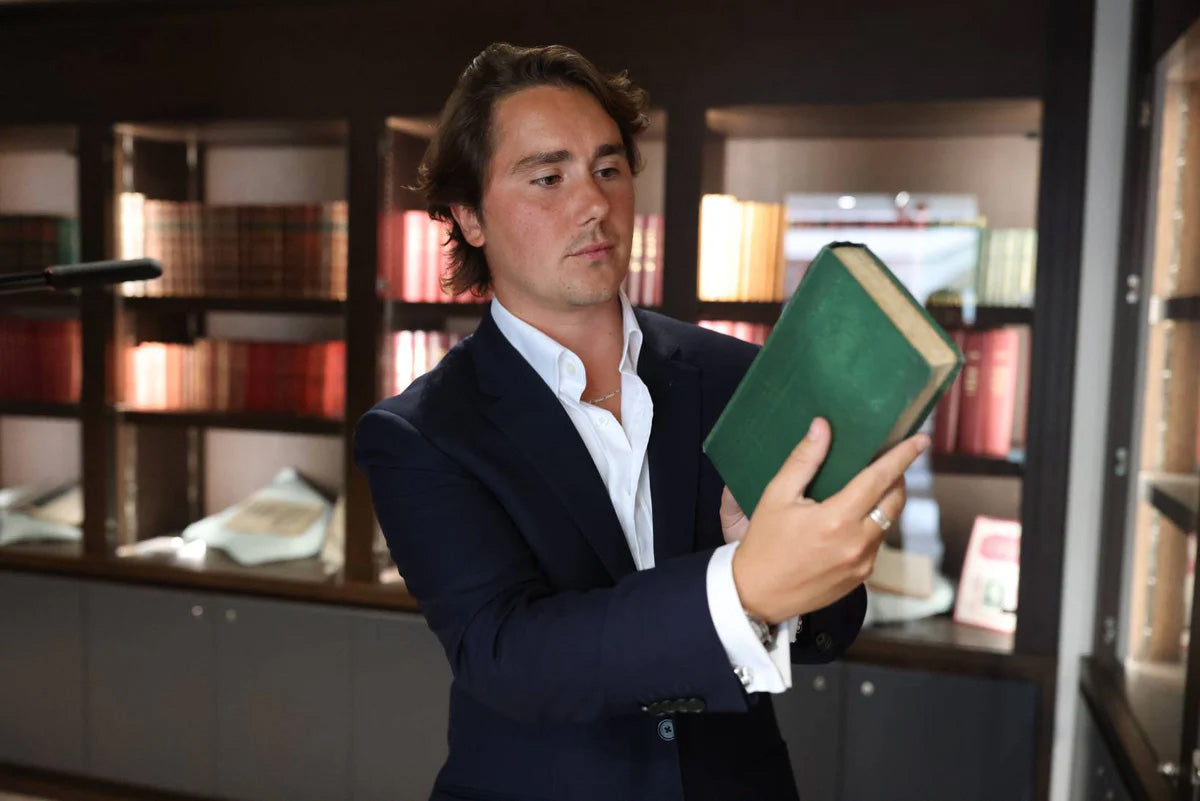


Nineteen Eighty-Four (1984) | 1949, first edition, first impression, inscribed to Eleanor Jacques
First edition, first impression, inscribed by Orwell during the final months of his life to Eleanor Jacques, an early girlfriend and lifelong correspondent widely associated with the emotional and biographical inspiration for Julia in Orwell’s masterpiece.
London: Secker & Warburg, 1949. Octavo. Publisher’s original green cloth, in the original green dust jacket, housed in a custom morocco-backed slipcase. A superb example of one of the defining novels of the twentieth century, preserving the scarce green dust jacket issued concurrently with the red variant at publication. Both colours were published simultaneously, with no established priority, and the green jacket is now increasingly difficult to encounter in collectible condition.
Inscribed by Orwell to the front free endpaper:
“To Eleanor, with much love, Eric”
The use of Orwell’s deeply personal Christian name rather than the more formal “George Orwell” or “Geo. Orwell” found in the few other recorded inscribed copies is especially notable, lending the volume an intimacy almost entirely absent from surviving presentation copies of the novel.
Eleanor Jacques occupied an unusually important place in Orwell’s private life. The two met in Southwold in the early 1930s while Orwell was staying with his parents and formed an intimate relationship which endured, in different forms, throughout his life. Their meetings, often arranged discreetly in the countryside, and Orwell’s later recollections of them have long been linked by scholars and biographers to the emotional and physical conception of Julia in Nineteen Eighty-Four.
In one surviving letter Orwell recalled a day spent together and “the deep beds of moss... I shall always remember that, & your nice white body in the dark green moss”, an intensely personal memory that has frequently been compared with Winston’s recollection of Julia’s body gleaming white against the landscape of the novel’s “Golden Country”.
Jacques’s marriage in 1934 to Orwell’s friend Dennis Collings appears to have ended the possibility of a fuller romantic attachment, but the emotional connection between Orwell and Jacques endured. Their surviving correspondence provides a rare glimpse of Eric Blair rather than George Orwell, making the use of “Eric” in this inscription particularly significant.
Nineteen Eighty-Four was published on 8 June 1949, when Orwell was already gravely ill with tuberculosis. He had spent much of the preceding period at Cranham Sanatorium and, by September, had been admitted to University College Hospital in London as his condition deteriorated. He died there on 21 January 1950, only seven months after the novel appeared.
The extraordinarily narrow interval between publication and Orwell’s death left very little opportunity for presentation copies to be inscribed. Genuinely inscribed copies of Nineteen Eighty-Four are consequently of the utmost rarity. Only two other inscribed copies appear to have surfaced publicly at auction in the past sixty years, of which only one was a true first edition. Both were signed “Geo. Orwell”.
Against that background, the present copy occupies an exceptional position. It is a first edition, first impression of Orwell’s final novel, inscribed not merely to a friend or contemporary but to a woman closely associated with the emotional and biographical origins of one of its central characters, and signed with the private name by which she had known him long before his international fame.
The copy was almost certainly inscribed during Orwell’s final illness, either at Cranham Sanatorium or at University College Hospital. The inscription therefore belongs to the closing months of his life, adding considerable poignancy to the simple words “with much love, Eric”.
More than simply a signed first edition, this is an exceptional association copy connecting Orwell directly with one of the most important personal relationships underlying his final masterpiece. The combination of recipient, inscription, edition and date places it among the most significant presentation copies of Nineteen Eighty-Four to have emerged.
A landmark twentieth-century literary artefact and an exceptional surviving presentation copy of Orwell’s masterpiece.